
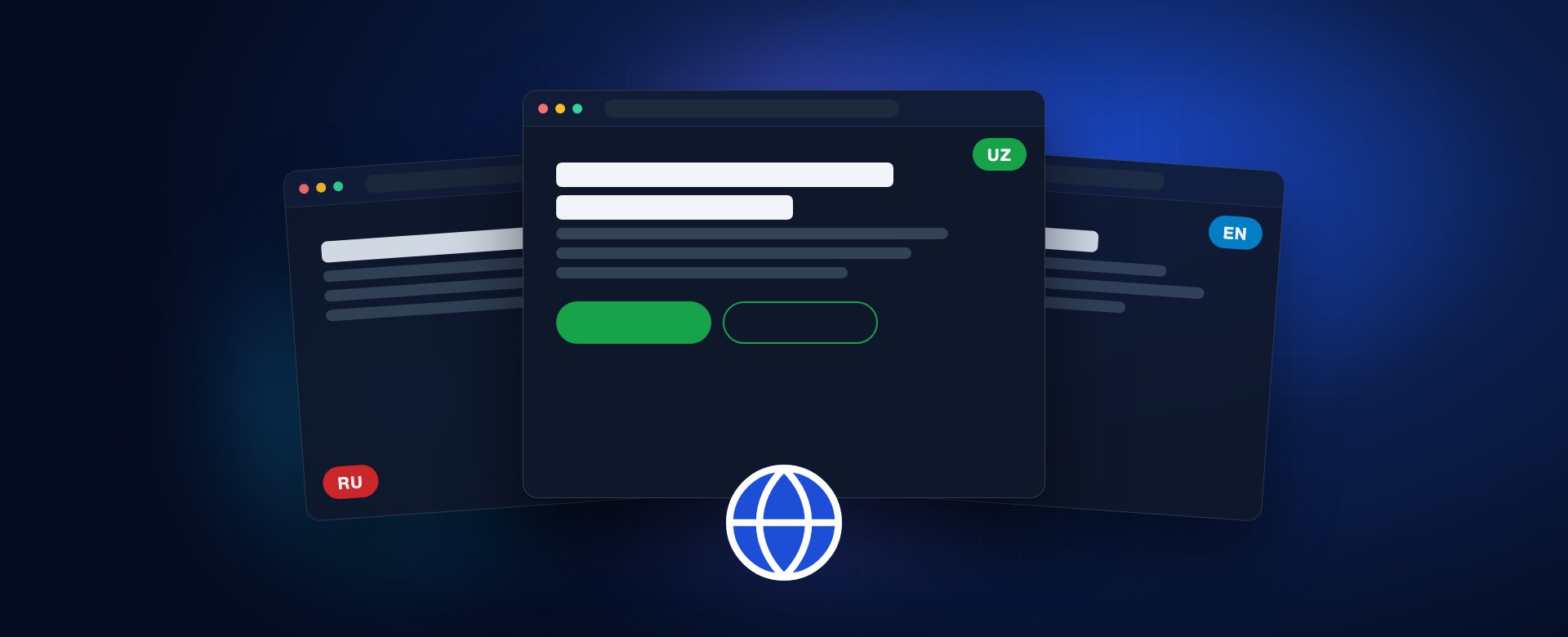
A multilingual website in Uzbekistan is not a courtesy translation. It is how you get found by the people who look for your services in Russian, in Uzbek and sometimes in English. Written for foreign companies in Tashkent and English-speaking owners, this guide covers who searches in which language, how the site works technically, the effort involved and the mistakes that cost you search traffic.
Who searches in which language
In Tashkent, a large share of business correspondence and service searches still happens in Russian. Many managers, procurement teams and private customers search this way, especially in the capital: "dentist near me", "apartment renovation Tashkent" or "website development Tashkent", typed in Russian.
Uzbek is the state language and the native language of most people in the country. Many users, particularly younger people and those outside the capital, search in Uzbek using the Latin alphabet, with queries such as "sayt yaratish" or "stomatologiya Toshkent". If your site has no Uzbek version, there is simply nothing to show for those searches.
English is needed less often, but where it is needed it matters a great deal: tourists, foreign partners, investors, head-office colleagues and staff of international companies living in Uzbekistan.
- Services for Tashkent residents (clinics, salons, restaurants, renovation): usually Russian + Uzbek.
- B2B, manufacturing, construction: Russian + Uzbek, plus English if you have foreign clients or a foreign parent company.
- Hotels, tourism, export, education: Russian + Uzbek + English.
How to work out which languages you actually need
No guessing required. Check which language customers use in Telegram and WhatsApp messages, calls and reviews. If you already have a site, open the search queries report in Google Search Console or Yandex Webmaster: it shows which language and which alphabet people use to find you. People in Uzbekistan use both Google and Yandex, so set up the language versions correctly for both.
What a multilingual website means technically
A website in two or three languages is not a "translate" button. It is several complete versions of the same pages, each of which search engines can see and index separately.
A separate URL for each language
Each language version has its own address, for example /ru/uslugi/, /uz/xizmatlar/, /en/services/. If the language only switches through a cookie or a script on the same address, the search crawler sees one version, and the others do not exist for Google and Yandex.
The hreflang attribute
Hreflang tags tell search engines "these pages are the same content in different languages". For a typical site in Uzbekistan that means the codes ru, uz, en and x-default for the fallback version. The key rule is reciprocity: every version points to all the others and to itself. If the link only runs one way, the search engine may ignore it.
The language switcher
The switcher should take visitors to the same page in the other language, not back to the homepage. Label each language in that language: Russian written in Cyrillic, "O‘zbekcha", "English". And do not redirect visitors automatically by IP address. Someone who deliberately opened the Russian version should stay on it, and the crawler needs access to every version.
Translated meta tags
Not only the visible text needs translating. The title, meta description, headings, image alt text, button and form labels, link previews for Telegram and social networks, the page slug and the lang attribute all have to be in the language of that version. People see the title and description in search results and decide whether to click.
Uzbek: Latin script and the Cyrillic question
The official alphabet for Uzbek is Latin, and we recommend it for the main Uzbek version of your site. Many people, especially older readers, still read Uzbek comfortably in Cyrillic script. If that is your audience, Cyrillic Uzbek should be a separate version with its own code (uz-Cyrl), not passages mixed into the Latin page. Also write the letters o‘ and g‘ with the correct character, not a random apostrophe, or the text looks careless.
Human translation, not machine translation
Machine translation is fine as a first draft, not as finished copy. It mixes up terms, produces literal renderings of Russian phrasing and does not know how your industry talks to customers. Every version should be proofread by a native speaker of that language, especially prices, terms, service names and legal text. Copy that reads well in English but awkwardly in Uzbek tells local customers the site was not written for them.
Comparison: three approaches to languages
| Single-language site | Auto-translate widget | Proper multilingual site | |
|---|---|---|---|
| Do search engines see other languages | No | Usually not: the translation is generated in the browser | Yes, every version is indexed |
| Text quality | Good, but in one language only | Unpredictable, errors in terminology | Proofread by a native speaker |
| Title and description | One language only | Not translated for search results | Written for each language |
| Customer trust | Part of the audience is lost | Suffers because of errors | Customers read in their own language |
| Effort at launch | Minimal | Minimal | Copy and proofreading in each language |
How much effort it takes
The technical part (separate URLs, hreflang, the switcher, meta tags) is done once, during development. The main work is the copy, and it grows with every language. As a guide:
- Copy: each language is another full set of texts for every page, plus a title and description.
- Proofreading: a native speaker needs to check each version before launch.
- Updates: a new service, promotion or price has to change in every version at once, or the versions drift apart.
A practical order of work:
- Decide who the site is for and choose the 2–3 languages your customers actually need.
- Prepare the copy in your main language and agree the page structure.
- Get the translations done and have a native speaker proofread them.
- Write a separate title and description for every page in every language.
- After launch, check in Google Search Console and Yandex Webmaster that every version is being indexed.
To compare budgets, see our guide to website costs in Europe.
Common mistakes
- A site in one language only. Many potential searches pass you by, and some visitors leave without finding text in their language.
- An auto-translate widget instead of real versions. The search engine sees one language, and the customer sees text full of errors.
- Mixed pages. Uzbek text with a Russian menu, untranslated buttons and form messages in English. The same goes for Latin and Cyrillic mixed on one Uzbek page.
- The same meta description in every language. A Russian description under an Uzbek title looks like a mistake in search results and lowers the click-through rate.
- A switcher that goes to the homepage. Someone was reading a service page, changed the language and got lost.
- One-way hreflang or none at all: the versions compete with each other instead of supporting each other.
- Automatic redirects by IP, which leave some versions unreachable for both people and crawlers.
If you already have a site and are not sure the language versions are set up correctly, that is checked as part of SEO optimization.
If you run a clinic or dental practice, see our separate clinic website checklist: pages, appointment requests and patient trust.
A multilingual website in 7 working days
If you need a business website in Russian, Uzbek and English, we have a ready-made "website in 7 days" offer:
- 3–5 pages, up to 3 languages (RU / UZ / EN);
- launch in 7 working days, with the clock starting once we have a complete brief and the deposit;
- 4 500 000 UZS all-in, paid 50/50: half before work starts, half at launch;
- fast on mobile, responsive design and basic SEO;
- a control panel where you edit texts and photos yourself;
- the domain, hosting and panel are registered in your name; hosting, SSL and 3 corporate mailboxes are included as a gift for the first year.
Online stores, booking systems and custom features are a separate service: web development built around the task. You can see examples of our work in the portfolio, and ask a question on the contact page.
Frequently asked questions about multilingual websites
Do I need an Uzbek version if my customers speak Russian?
Most likely, yes. Some of your future customers search for services in Uzbek using the Latin alphabet, and without an Uzbek version your site has nothing to show for those searches. Text in a customer's native language also earns more trust.
Can I rely on automatic translation?
As a draft, yes. As finished copy, no. An auto-translate widget usually does not create separate pages that search engines can index, and unedited machine translation contains errors in terms and phrasing. Every version should be checked by a native speaker.
Latin or Cyrillic script for the Uzbek version?
We recommend Latin script for the main Uzbek version, because it is the official alphabet. If a significant part of your audience reads Cyrillic, that becomes a separate language version rather than being mixed with Latin on the same page.
Do I need English?
Yes, if your customers include tourists, foreign partners or expats, or if your head office and investors read the site. For services aimed only at residents of Uzbekistan, Russian and Uzbek are usually enough.
How many languages are included in the "website in 7 days" offer?
Up to three languages: Russian, Uzbek and English. It is a 3–5 page website for 4 500 000 UZS all-in, paid 50/50. The timeline is 7 working days, starting once we have a complete brief and the deposit.